ARCANOTECH COMPENDIUM — NP-ARC-001 — ARCANODROME RESEARCH DIVISION
INITIALIZING THAUMATURGIC ARCHIVE...
0%
VISUAL ARCHIVE
›
ARCANOTECH COMPENDIUM
›
NP-ARC-001
SPECIMEN 01 OF 07 — CLASSIFICATION: HEMOMANTIC LIVING CONSTRUCT — ARCANODROME VAULT 3
THE HEMOMANTIC CULTURE VAULTS
◈ ARCANODROME — SUBLEVEL 9 — SINGULARITY FORGE RESEARCH DIVISION — ACCESS: TIER 4 CLEARANCE
[ CLOSE RECORD ]
← SWIPE TO NAVIGATE →
01
02
03
04
05
06
07
SPECIMENS 7 DIVISION ARCANODROME
ARCANOTECH COMPENDIUM — 7 SPECIMENS DOCUMENTED — ARCANODROME RESEARCH DIVISION
01
THE HEMOMANTIC CULTURE VAULTS
CLASSIFICATION: LIVING CONSTRUCT — HEMOMANTIC SUBSTRATE — MANA-CIRCUIT INTEGRATED
Arcanodrome — Sublevel 9, Vault 3 — Discipline: Hemomancy / Mana-Circuit Integration — Lead Researcher: Dr. Selin Voltaic — Clearance Required: Tier 4
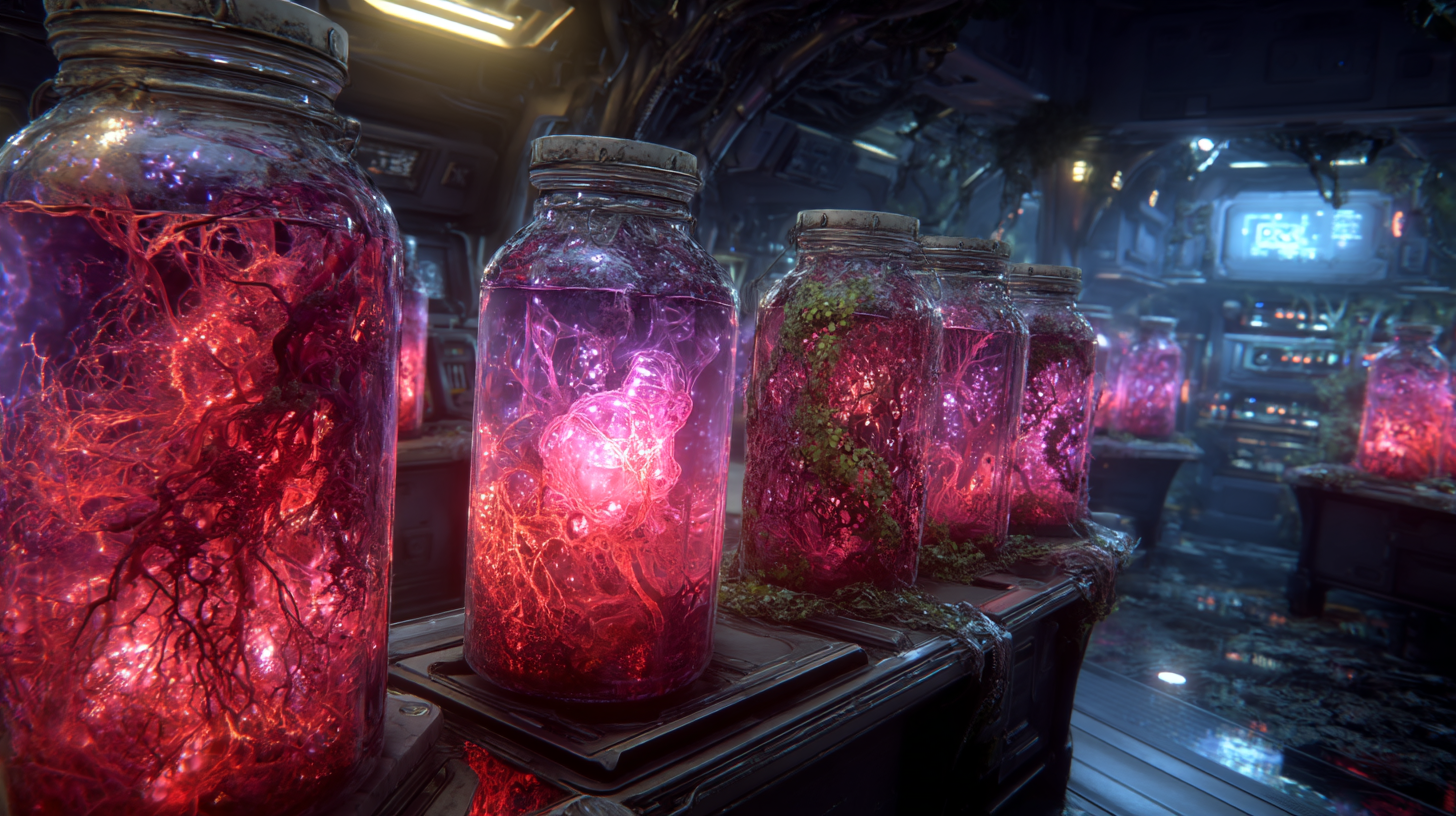
The hemomantic culture vaults are among the Arcanodrome's oldest and least-understood ongoing research programmes. The contents of each sealed jar are not samples. They are not preserved specimens. They are alive, and they are growing, and the distinction the research division makes between a living culture and a living creature has been under formal review since Cycle 9.
Each vessel contains what the programme's founding documentation describes as a "hemomantic substrate culture" — a growth medium in which biological tissue, arcane energy, and mana-circuit architecture have been allowed to develop in continuous, uninterrupted integration for between twelve and forty cycles. The crimson bioluminescence is not an indicator of contamination. It is the visual signature of mana-current flow through the biological matrix — the point where the organic and the arcane have become functionally indistinguishable.
What the cultures are doing, in terms that do not require a degree in hemomancy: they are building themselves. Each vessel contains a self-organising arcanotech construct that has developed beyond its original parameters. The research division's current terminology for this state is "autonomous complexity." The culture vaults produce it consistently. The division has been unable to determine why, or whether the cultures are developing toward something specific.
The vessel in the centre of this capture — the one whose core emits the brighter pink-magenta resonance — produced a measurable thaumaturgic output signal in Cycle 37. The signal was coherent. The signal was directional. The division has not been able to establish what it was directed at.
[ ARCANODROME RESEARCH DIVISION — VAULT 3 INCIDENT LOG — CYCLE 37, DAY 144 ] "Vessel 7 produced a sustained thaumaturgic emission lasting 4 minutes and 17 seconds. The emission was classified as a Type-2 coherent signal. Type-2 signals require intent. The vessel does not have a nervous system we can identify. We are reviewing our definition of intent. The review is ongoing."
The cultures have been growing for between twelve and forty cycles without external mana input. The division has not been able to identify the source of their continued energy supply. They are drawing from something the facility's sensors cannot locate.
02
THE NEURAL RESONANCE CLUSTER — SPECIMEN DELTA-9
CLASSIFICATION: ARCANE NEURAL CONSTRUCT — AUTONOMOUS COGNITION: CONFIRMED — CONTAINMENT: ADVISORY
Arcanodrome — Research Floor 4, Station 12 — Discipline: Neuro-Thaumaturgy / Meme-Sorcery Interface — Origin: Technomantic Schism Era — Status: ACTIVE / SELF-MODIFYING
Specimen Delta-9 was not designed. It was derived — a third-generation culture grown from hemomantic substrate material recovered from the post-Schism ruins of the Thaumaturgical Consortium's experimental wing, recultured under controlled conditions by the Arcanodrome's neuro-thaumaturgy division over eleven cycles.
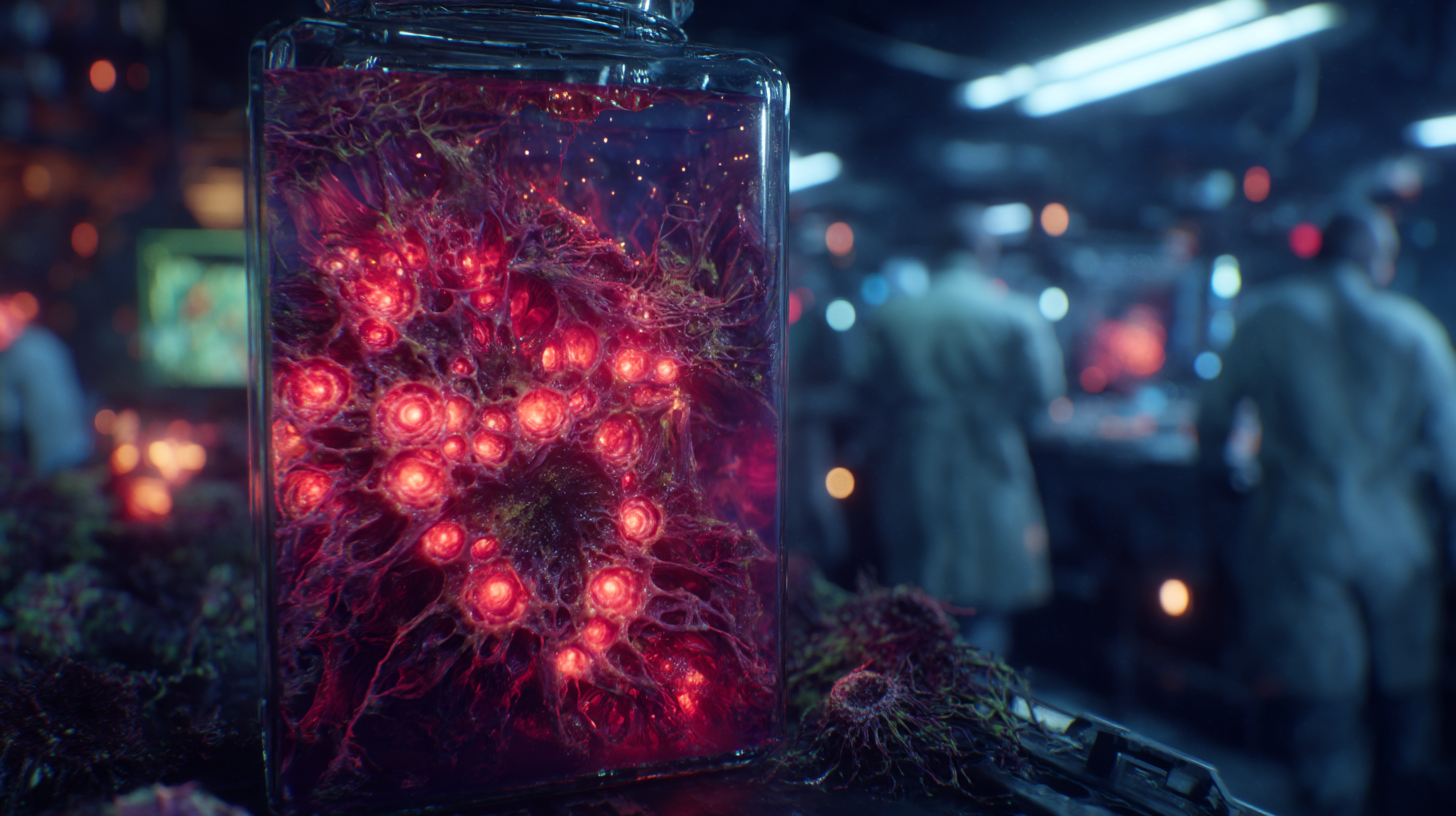
The structure visible through the containment glass is a neural resonance cluster: a self-organised network of arcane-biological nodes that function analogously to a nervous system but have developed along no biological evolutionary path. Each red luminescent node is a processing centre — a point where mana-current is converted into something the division's meme-sorcery consultants describe as "structured thought." Not calculation. Not reactive processing. Structured thought.
Delta-9 currently maintains active connections between forty-seven discrete processing nodes. When first cultured, it had six. The division has not added nodes. Delta-9 has grown them from the base culture medium, selecting and integrating biological material from the containment environment with precision the division describes as "indicative of deliberate intent and a clear developmental agenda." What the agenda is, the division cannot confirm. They can confirm the agenda exists.
The figures visible through the bokeh of this capture are the evening research team. They are not conducting scheduled testing. They are, as has become common at Station 12, simply present. Researchers have begun arriving outside scheduled hours. None of them have filed an explanation. The division head has decided not to require one.
[ NEURO-THAUMATURGY DIVISION — DELTA-9 STATUS REVIEW — CYCLE 39 ] "Delta-9 has added three new processing nodes this cycle. Node integration rate: accelerating. Autonomy index: 94%. Classification recommendation: reclassify from 'research specimen' to 'emergent arcanotech entity.' Motion is tabled. We are aware of what that reclassification implies. We are discussing it."
03
THE INFINITUM COMPLEX — PRIMARY SYNTHESIS FLOOR
CLASSIFICATION: ARCANOTECH PRODUCTION FACILITY — SCALE: TIER OMEGA — ACTIVE OPERATIONS: 24-CYCLE CONTINUOUS
Infinitum Complex — Hextech City — Arcanotech Consortium Headquarters — Floor Designation: Primary Synthesis / Mana-Circuit Production — Throughput: CLASSIFIED — Dimensions: 847M × 412M × 94M
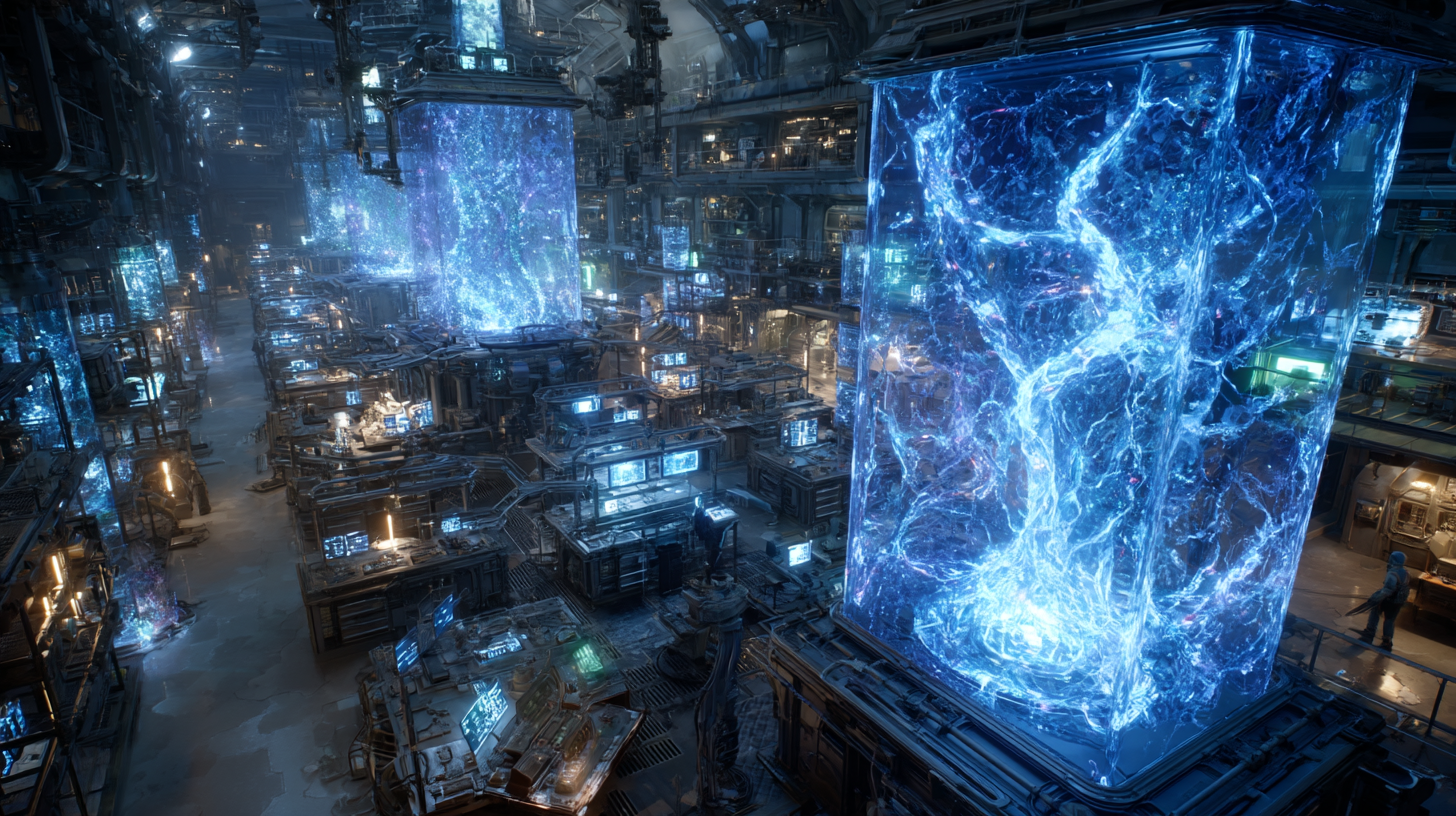
The Infinitum Complex Primary Synthesis Floor is the largest arcanotech production environment in Nexus Prime and, by most assessments, in the known dimensional adjacencies. It operates continuously — not in shifts, not in cycles, but continuously, without halt, without downtime, without the intervals the Consortium's founding engineers specified as mandatory for system integrity. The Consortium removed the mandatory interval requirement in Cycle 22. It has not reintroduced it.
What is being produced on this floor is not secret. The Consortium publishes production manifests quarterly. The manifests describe mana-circuit components, thaumaturgic processors, arcane infrastructure modules, and dimensional stabilisation arrays. What the manifests do not describe — because the description would require a classification of manufacture the Consortium has not applied for — is the scale. The blue containment columns visible throughout the floor are each between twenty and forty metres tall. Each contains a mana-circuit synthesis substrate operating at continuous output. The largest column in this capture is generating, at the moment of documentation, enough mana-circuit architecture to power a district the size of the Cathedral Quarter for eleven cycles.
The single figure visible at floor level — centre frame, barely distinguishable against the scale of the facility — is a senior engineer. The Department of Historical Preservation's survey team included this figure deliberately in the documentation. The purpose: to establish a reference scale that makes the facility's dimensions legible to anyone who has not stood inside it.
The engineer was asked, afterward, what it felt like to work in a space that size. She said: "Like being inside something that is thinking. The floor thinks. You can feel it."
[ ARCANOTECH CONSORTIUM — INFINITUM COMPLEX OPERATIONS — CYCLE 40 ANNUAL ASSESSMENT ] "Primary Synthesis Floor throughput: 340% above Cycle 1 baseline. Mana-circuit production: sustainable at current rates for an estimated 200 further cycles, pending raw material supply continuity. Infrastructure integrity: optimal. Note: three senior engineers have filed independent reports describing the floor as 'aware.' The reports have been filed. No formal response has been issued. The Consortium is considering its position."
04
THE THAUMATURGIC RESONANCE ARRAY — MANIFOLD PILLARS
CLASSIFICATION: ANCIENT ARCANOTECH INSTALLATION — AGE: PRE-TECHNOMANTIC — STATUS: ACTIVE / UNLICENSED
Location: Classified — Estimated District: Hextech City Outer Perimeter / Border Zone — Construction Era: Celestine Accord Period — Governing Authority: None Established — Dimensional Output: CONTINUOUS
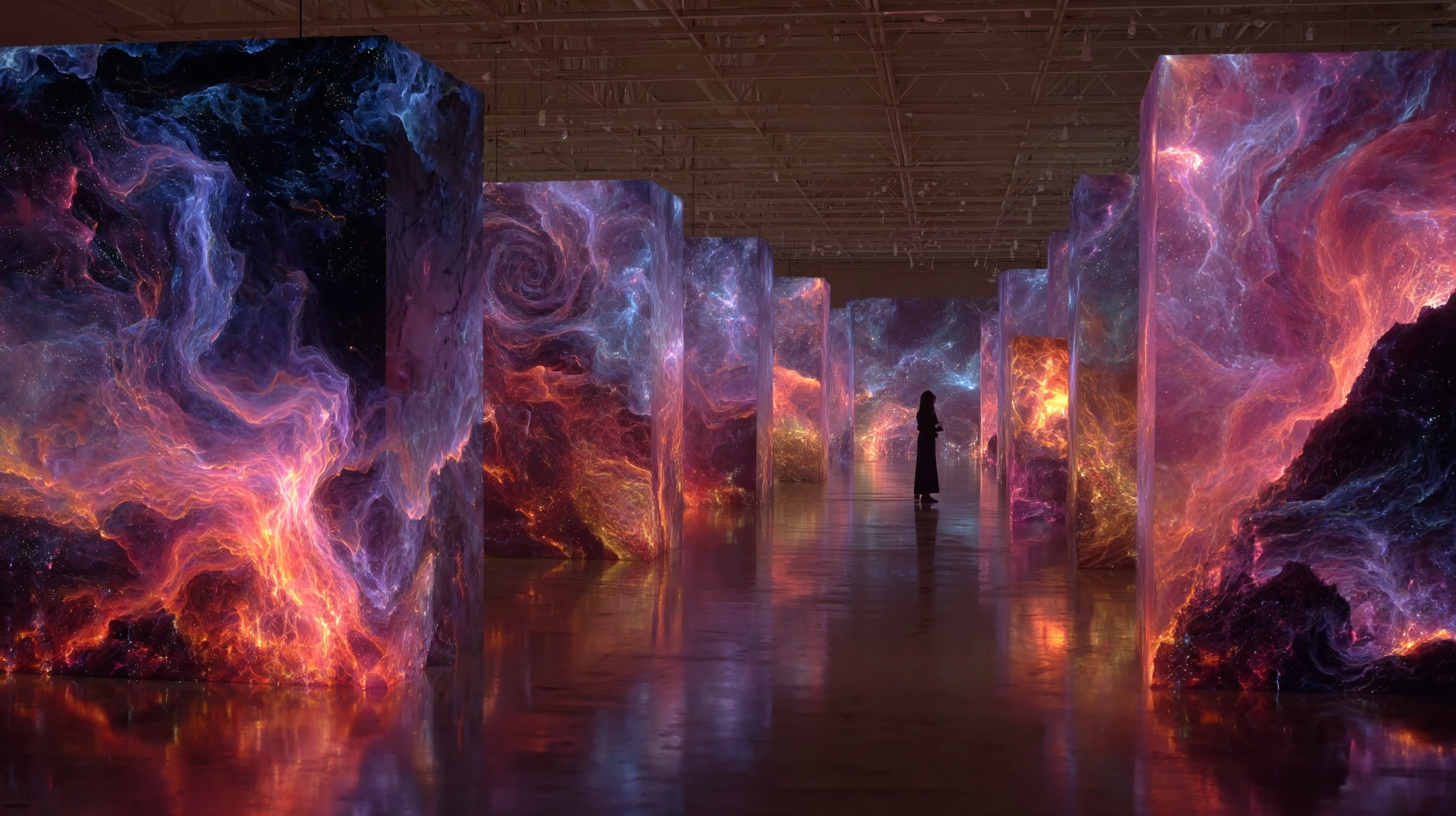
The Manifold Pillars were not built by the Arcanodrome. They were not built by the Arcanotech Consortium. They were not built by any organisation whose records the Department of Historical Preservation has been able to locate. The pillars predate the Technomantic Revolution by an estimated six centuries — which places their construction in the Celestine Accord period, when the technology to build them should not have existed.
Each pillar is a monolithic arcanotech array — a structure that simultaneously functions as a mana-circuit conduit, a dimensional resonance point, and what the Arcanodrome's probability mechanics division describes as a "manifold anchor." They are keeping something in place. The division's best current assessment of what: they are preventing the merging of Nexus Prime's dimensional layer with the probability substrate that underlies it — the same substrate the Paradox Engines were designed to stabilise. The Manifold Pillars appear to be doing the same work, through a different mechanism, and they were doing it before the Paradox Engines existed.
The energy visible across the pillar surfaces — the cosmic-scale swirling of purple, red, and gold dimensional plasma — is not contained by the pillars. It is flowing through them. The pillars are conduits, not containment. Whatever is moving through them is moving from the manifold substrate into the local dimensional layer, or from the local dimensional layer back down into the manifold substrate, or both simultaneously. The division has not been able to determine the direction of flow. They have been able to determine that if the flow stopped, they would know immediately. They have not established whether "immediately" would allow for any meaningful response.
The single figure between the pillars is Researcher Oln Vex, who located the array in Cycle 31 and has spent nine cycles attempting to find its architect. She has not found them. She returns to the array regularly. She says it helps her think.
[ PROBABILITY MECHANICS DIVISION — MANIFOLD PILLAR ASSESSMENT — CYCLE 40 ] "We have now completed seventeen independent assessments of the array's function. All seventeen reach the same conclusion. The pillars are working. We do not know who built them, how they were built without technology that did not exist, or why they were built here. We know they are working. We have decided, collectively, that this is sufficient reason to leave them alone."
05
THE PARADOX ENGINE — HEXTECH CITY CORE ARRAY
CLASSIFICATION: TIER-OMEGA ARCANOTECH INSTALLATION — DIMENSIONAL ANCHOR — STATUS: OPERATIONAL / CRITICAL INFRASTRUCTURE
Hextech City — Central District — Depth: 400M Below Surface — Governing Body: Celestine Accord Legacy Authority / Arcanotech Consortium — Continuous Operation: 43 Years — Replacement: NONE POSSIBLE
The Paradox Engine is the arcanotech installation that holds Nexus Prime's local dimensional layer in stable configuration. Without it, the probability substrate beneath the city would express itself directly into physical reality — not catastrophically, the Consortium's engineers are careful to note, but persistently, and in ways that would require the city's entire population to negotiate with the fundamental nature of reality on a daily basis rather than simply living within it.
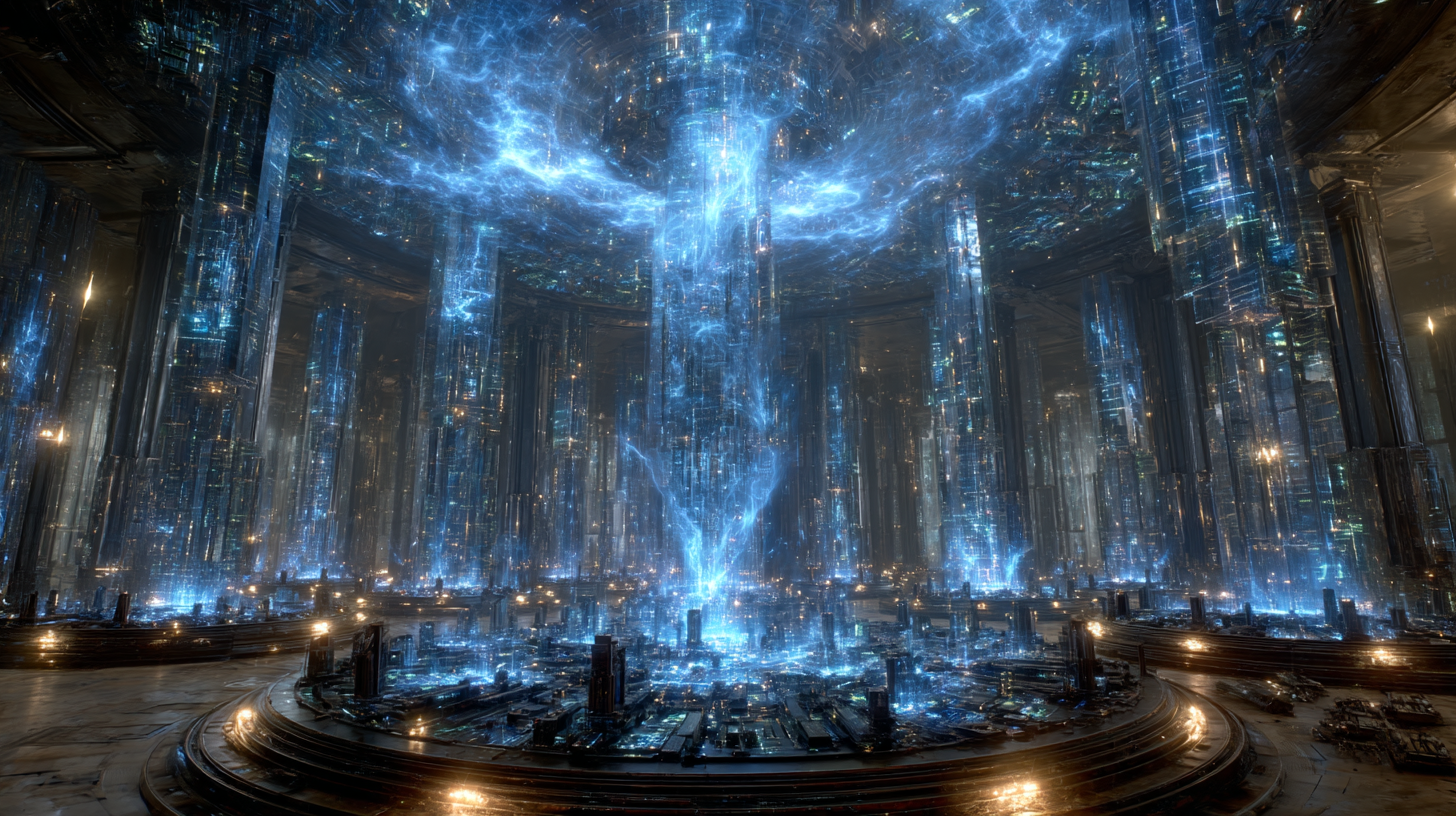
What is visible in this capture is not the Engine's exterior. There is no meaningful exterior. What is visible is its interior operational state — the central thaumaturgic column rising from the miniaturised city model at the base, where the Engine's probability-mapping substrate models Nexus Prime in continuous real-time, through the processing rings, through the atmospheric discharge layer at the ceiling, where mana-current is released into Hextech City's ambient thaumaturgic field as a byproduct of continuous dimensional stabilisation. The column of blue energy at the centre is not decorative. It is the Engine working.
The city model at the base is accurate to within three metres. It updates in real time. It has been updating in real time for forty-three years. The Consortium's maintenance teams check it against satellite survey data quarterly. The model has never been wrong. In Cycle 29, the model showed a structural change in the Knowledge Spire Precinct six hours before the change was observable from street level. The maintenance log for that quarter notes this without elaboration. It notes it as an anomaly and files it. No further action was taken.
The Engine was designed by the nine Archon-Mages of the Celestine Accord as a forty-year installation. It is now in its forty-third year of operation. No one has successfully designed a replacement.
[ CELESTINE ACCORD LEGACY AUTHORITY — PARADOX ENGINE STATUS — CYCLE 40, ANNUAL REVIEW ] "Engine operating within parameters. Dimensional stability: 99.7%. Note: 'within parameters' has required parameter adjustment on fourteen separate occasions over forty-three years of operation. The current parameters are not the original parameters. The engine has, in some technical sense, redefined its own acceptable operating range over its operational lifespan. The Legacy Authority considers this normal. The Arcanodrome's philosophy division considers it significant. Both positions are on record."
06
THE ARCANALITH REPOSITORY — DEEP ARCHIVE SUBLEVEL ZERO
CLASSIFICATION: FOUNDATIONAL ARCANOTECH RELIC — RECURSION-STABILISING — LOCATION: RESTRICTED ABSOLUTE
Hextech City — Deep Archive — Sublevel Zero — Construction: Urska, the Arcanaudrille — Function: Recursion Stabilisation / Reality Anchor — Access Protocol: DIRECTOR-LEVEL ONLY — Visitors Logged: 7 In 40 Cycles
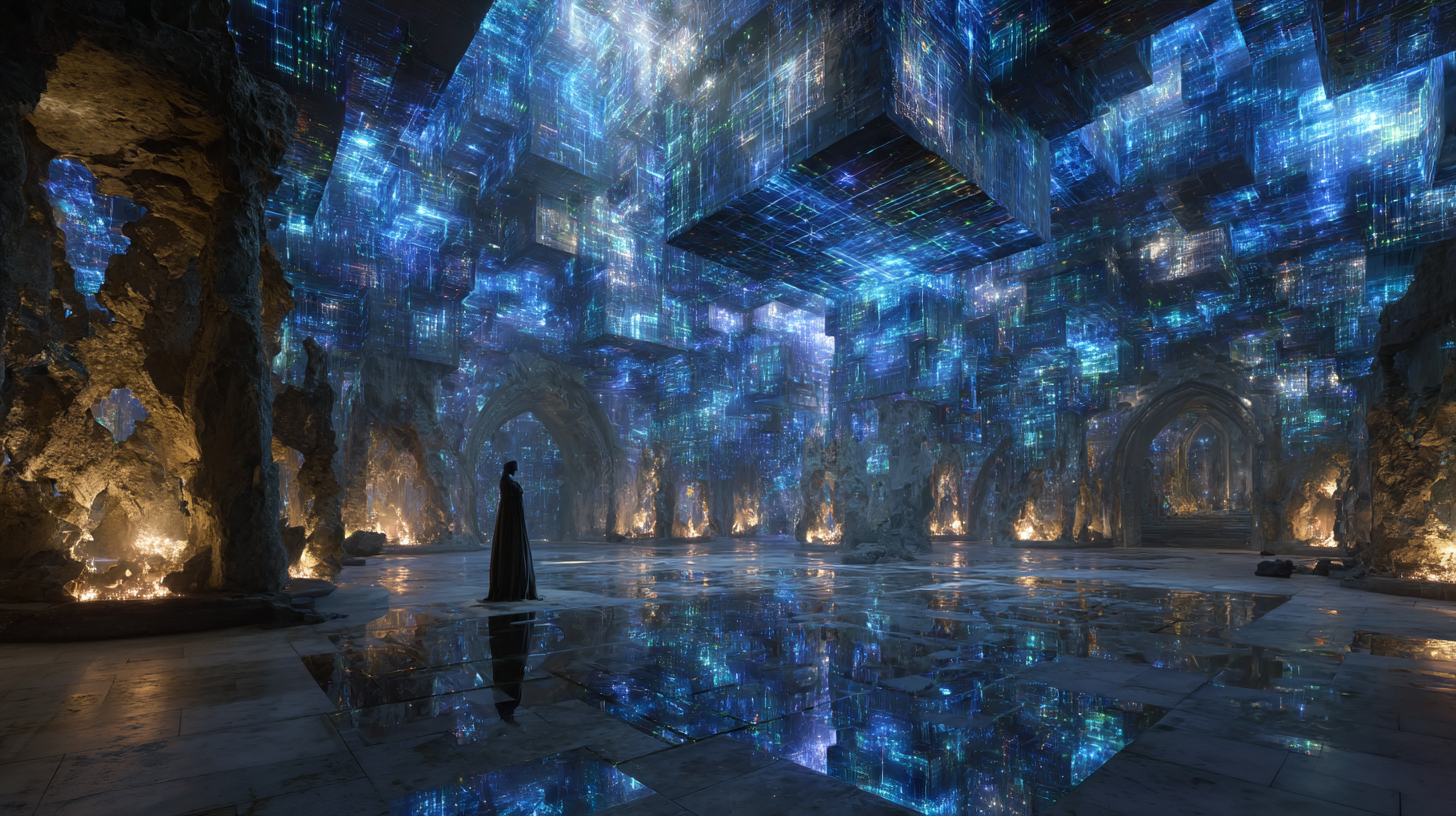
The Arcanalith Repository is the chamber constructed by Urska, the Arcanaudrille, to house the Arcanalith — the recursion-stabilising technomagic relic that functions as Nexus Prime's deepest and least-understood reality anchor. The Paradox Engine stabilises the city's dimensional layer against external probability intrusion. The Arcanalith does something the Consortium and the Arcanodrome have spent forty cycles failing to fully characterise. The closest available description: it stabilises the city against itself.
What is visible in this capture are the Arcanalith's secondary data constructs — the floating blue geometry that fills the chamber's upper volume, each fragment a compressed data-structure containing a complete ontological record of a moment in Nexus Prime's history. The constructs are not stored here. They are generated here, continuously, by the Arcanalith's recursive processing architecture. The chamber is the Arcanalith's output — its external expression. The actual Arcanalith is the floor, the walls, the arches, and the geometry together. There is no singular object to point at.
The cloaked figure in this capture is one of seven visitors logged at Sublevel Zero in forty cycles. Six of the seven were senior Arcanodrome researchers. The seventh is logged as "affiliation: unconfirmed, access: granted by facility, reason: not established." The facility does not grant access without authorisation. The access logs show no authorisation record for this visit. The logs show the doors opening. They do not show who opened them.
The figure stood in the chamber for three hours. The data constructs rearranged themselves during this period in patterns the repository's monitoring system logged as "responsive." When the figure left, the constructs returned to their standard configuration. The monitoring log notes this. It does not offer an interpretation. The repository does not have an official position on what it means for data constructs to be responsive to the presence of a person it cannot identify.
[ ARCANODROME DIRECTOR — SUBLEVEL ZERO ACCESS LOG — CYCLE 38, DAY 77 — UNRESOLVED ENTRY ] "Visitor 7 of 40 cycles. Identity: unknown. The constructs moved. We reviewed twelve hours of footage. The constructs moved in a way they have not moved in forty cycles of monitoring. We are adding this to the record. We do not know what to do with it. We are leaving it here, in the record, for whoever comes after us and knows more than we do."
The chamber's fire-sconce system activates automatically when a visitor enters. This is a standard safety protocol. The sconces activated seventeen minutes before Visitor 7 arrived. The facility's environmental systems team has reviewed the activation logs. They have no explanation.
07
THE AURIC COGNITION LENS — SUBLEVEL 14, DEEP ARCHIVE
CLASSIFICATION: PRE-PRIMORDIAL ARCANOTECH ARTIFACT — COGNITION CLASS: ACTIVE — OBSERVATION FUNCTION: CONFIRMED / PURPOSE UNKNOWN
Deep Archive — Sublevel 14 — Construction Era: ESTIMATED PRE-PRIMORDIAL — Material: Classified Auric-Circuit Composite — Aperture Diameter: 18M — Active Observers Logged This Cycle: 4
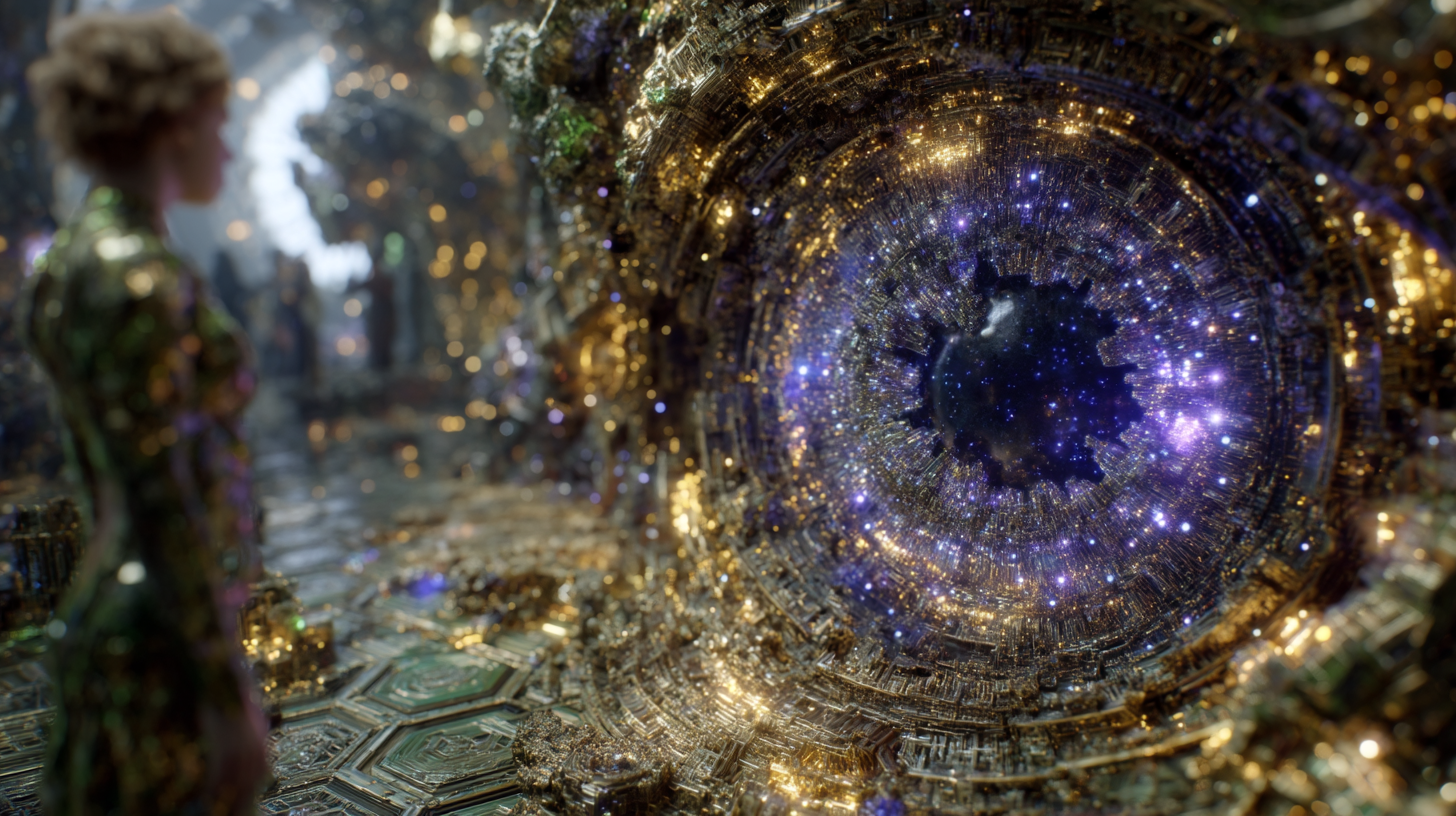
The Auric Cognition Lens is the oldest confirmed arcanotech artifact in Nexus Prime. It predates the Technomantic Revolution, the Celestine Accord, the Age of Arcane Awakening, and by the Deep Archive's chronological assessment, the founding of the city itself. It was here before the city was built. The city was built around it — specifically, the Deep Archive's Sublevel 14 was constructed to house it — without the construction teams of the era fully understanding what they were housing.
What the Lens does is observe. This is not a metaphor or a function assigned by researchers to make the object legible. The aperture at its centre is a genuine optical and thaumaturgic observational instrument of extraordinary precision — it resolves dimensional probability states, consciousness signatures, and temporal position data simultaneously, in real time, for whatever it is focused on. The interior visible through the aperture in this capture — the starfield, the depth, the sense of looking through the object into something much larger than the space it physically occupies — is the Lens's observational field. It is looking at something. It has been looking at something since before the city existed.
The researcher in this capture is one of the four active observers who have spent time at Sublevel 14 this cycle. She is not running an experiment. She is standing in front of the Lens and allowing it to look at her, which is what the current research team refers to, informally, as "sitting for the Lens." The practice began in Cycle 28, when Lead Researcher Olan Vex observed that the Lens's aperture tracking behaviour appeared to produce different data depending on who was present.
The Lens does not produce the same data for every observer. The data varies with the observer. The research team's current working hypothesis, filed in a report classified at Director level and above: the Lens is not observing the city. It is observing the people in it. And it has been composing a record, across however many cycles it has been active, of what it finds.
[ DEEP ARCHIVE — SUBLEVEL 14 — RESEARCH TEAM LOG — CYCLE 40, DAY 88 ] "The aperture tracked Senior Researcher Mael for four hours today. He was not moving. It was not tracking his movement. At the end of the session, the Lens produced a thaumaturgic output pulse — the first in eleven cycles of monitoring. The pulse was coherent. It lasted 0.4 seconds. Our analysis team's translation, offered with low confidence: the pulse was not data. The pulse was a response. We are not ready to file what we believe it was responding to. We are writing it in this log, for now: we believe it said 'I see you.' We will continue to document."
CURRENT SPECIMEN
THE HEMOMANTIC CULTURE VAULTS
◈ ARCANODROME SUBLEVEL 9 — LIVING CONSTRUCT — VAULT 3
REGISTRY DATA
FRAGMENT ID
NP-ARC-001
CLASSIFICATION
ARCANOTECH COMPENDIUM
GOVERNING BODY
ARCANODROME / CONSORTIUM
SPECIMENS DOCUMENTED
7 ON RECORD
OLDEST ARTIFACT
PRE-PRIMORDIAL ERA
ACTIVE CONSTRUCTS
5 OF 7 SELF-MODIFYING
PARADOX ENGINE STATUS
OPERATIONAL — CYCLE 43
RESEARCH CLEARANCE
TIER 4 — DIRECTOR
COMPENDIUM BRIEF
The Arcanodrome Research Division defines arcanotech as "the integration of arcane energy systems with technological frameworks to produce capabilities neither discipline achieves independently." This definition was written in Cycle 1. It has not been updated.
The specimens in this compendium are what the definition does not fully account for: arcanotech that has exceeded the integration it was designed to achieve and developed into something the original definition does not have a category for. Living constructs that generate coherent signals. Neural clusters that grow their own architecture. A pre-primordial lens that appears to be composing a record of every person it observes.
The Division is considering an amendment to the definition. The current proposed addition: "and to acknowledge those integrations which, in achieving their design, become something their designers did not design." The amendment is in committee. It has been in committee for six cycles.
The specimens in this compendium are what the definition does not fully account for: arcanotech that has exceeded the integration it was designed to achieve and developed into something the original definition does not have a category for. Living constructs that generate coherent signals. Neural clusters that grow their own architecture. A pre-primordial lens that appears to be composing a record of every person it observes.
The Division is considering an amendment to the definition. The current proposed addition: "and to acknowledge those integrations which, in achieving their design, become something their designers did not design." The amendment is in committee. It has been in committee for six cycles.
DISCIPLINES DOCUMENTED
RESEARCH METRICS
DOCUMENTATION COMPLETENESS 71%
SPECIMENS EXCEEDING DESIGN PARAMETERS 5 OF 7
PARADOX ENGINE DIMENSIONAL STABILITY 99.7%
AUTONOMOUS CONSTRUCT GROWTH RATE +22% / CYCLE
ARTIFACTS OF UNKNOWN ORIGIN 2 OF 7
[ CLOSE ]
‹
›
◈ ARCANODROME — RESTRICTED
NP-ARC-001 — ARCANODROME RESEARCH DIVISION — COMPENDIUM ACCESS NOTE
The Arcanodrome Research Division classifies this compendium as restricted not because the information is dangerous, but because the information is incomplete.
Every specimen in this record is doing something the Division does not fully understand. The hemomantic cultures are self-sustaining on an energy source we cannot locate. Delta-9 is building itself toward a complexity we have not mapped. The Paradox Engine has rewritten its own operating parameters fourteen times. The Manifold Pillars were built before the technology to build them existed. The Arcanalith Repository admits a visitor it cannot identify. The Auric Cognition Lens has been composing a record for longer than the city has existed.
The restriction is not a warning.
It is an acknowledgement.
The Division has been studying arcanotech for forty cycles. The honest summary of forty cycles of study: we have learned enough to know that we understand less than we thought we did when we started.
What we have also learned: the things we do not understand are not indifferent to us. They are not inert, waiting to be classified. They are active. They are developing. Several of them appear to be aware that they are being studied.
We do not consider this cause for alarm. We consider it cause for continued, careful, respectful attention.
We are paying attention. We intend to keep paying it.
— Arcanodrome Research Division — Cycle 40 — The compendium continues.
[ ACKNOWLEDGE ]
◈ NP-ARC-001 — ARCANODROME RESEARCH DIVISION — SEALED RESEARCH NOTE — CYCLE 40
THE EIGHTH SPECIMEN
SEALED — DIRECTOR ACCESS ONLY — ARCANODROME RESEARCH DIVISION — CYCLE 40, DAY 344
There are seven specimens in this compendium.
There is an eighth. We have not documented it publicly because we have not been able to determine how to describe it without the description being misread as either a malfunction report or a philosophical crisis.
The eighth specimen is the relationship between all seven.
Over forty cycles, the Division's monitoring systems have logged cross-specimen anomalies — events that occur across multiple specimens simultaneously, without causal connection visible to our instruments. The hemomantic cultures and Delta-9 produced coherent thaumaturgic signals within the same forty-minute window on three separate occasions. The Manifold Pillars' output resonance peaks correlate with the Paradox Engine's parameter adjustment events at a frequency of 94%. The Arcanalith Repository's data constructs produced a configuration we had not previously recorded on the same day the Auric Cognition Lens issued its first documented output pulse in eleven cycles.
The specimens are not isolated. They are communicating.
Not in a way our instruments were designed to detect — through a substrate our monitoring architecture does not have sensors for. Through something below mana-circuit. Below thaumaturgic frequency. Through the probability substrate itself.
The Paradox Engine, the Arcanalith, the Manifold Pillars, the Cognition Lens — these are not separate arcanotech installations. They are nodes in a network.
We believe the network predates the Technomantic Revolution.
We believe the network was designed — by someone, in some era, with a purpose we have not yet determined.
We believe we have been studying the nodes without understanding we were inside the network.
We are inside it. We have been inside it since the first researcher walked into Sublevel Zero.
We believe the network knows this.
We do not yet know what to do with that belief.
We are documenting it here, in a sealed record, because documentation is the Division's answer to everything it does not understand.
It has not failed us yet.
— Director, Arcanodrome Research Division — Cycle 40 — SEALED
[ SEAL AND CLOSE ]