PRIMORDIAL SITE EXCAVATION REGISTRY — NP-CHO-001 — DEPT. OF PARATEMPORAL ANTIQUITIES
INITIALIZING EXCAVATION ARCHIVE...
0%
VISUAL ARCHIVE
›
PRIMORDIAL EXCAVATION REGISTRY
›
NP-CHO-001
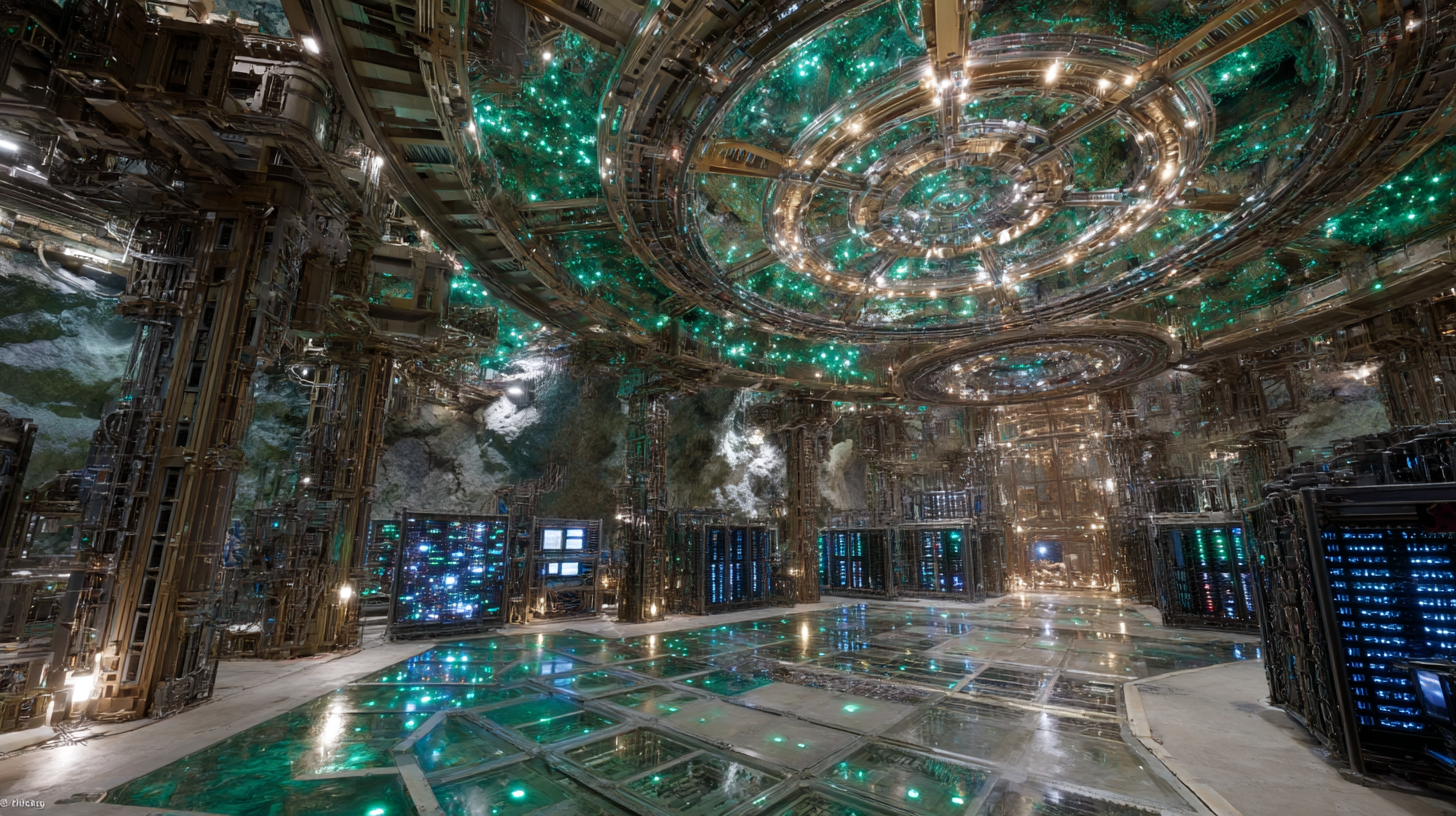
SITE 01 OF 06 — CLASSIFICATION: PRIMORDIAL COMPUTATION HALL — EXCAVATION STATUS: ACTIVE
THE AETHER CRYSTAL COMPUTATION HALL
⬡ HEXTECH CITY DEEP STRATUM — AETHER CRYSTAL SUBSTRATE — STILL PROCESSING — DEPT. OF PARATEMPORAL ANTIQUITIES
[ CLOSE RECORD ]
← SWIPE TO NAVIGATE →
01
02
03
04
05
06
SITES ACTIVE 6 STATUS ONGOING
EXCAVATION REGISTRY — 6 SITES — ALL CURRENTLY UNDER ACTIVE STUDY
01
THE AETHER CRYSTAL COMPUTATION HALL
CLASSIFICATION: PRIMORDIAL DATA COMPLEX — AETHER CRYSTAL SUBSTRATE — COMPUTATION: ACTIVE
Hextech City Deep Stratum — Level: -340M — Era: Estimated Pre-Primordial — Aether Crystal Density: Tier 9 — Discovery: Cycle 31 — Lead Excavator: Archivist Zephyr Novak
The Aether Crystal Computation Hall was not discovered. It was uncovered. The distinction matters to the Department of Paratemporal Antiquities, whose official excavation record for the site opens with the following note: "We did not find this. We found our way back to it. The Hall has always been here. The city was built above it, around it, without knowing it was here. The Hall is the city's foundation. This is not metaphorical."
What is visible in this capture is the Hall's primary processing chamber: a circular space approximately 180 metres in diameter, whose ceiling is a recursive array of Aether Crystal formations embedded in a gold-alloy framework that functions simultaneously as architectural structure and computational substrate. The green bioluminescence that fills the ceiling — the soft, cold light that the excavation team described as "like standing under a living sky" — is the visible signature of active Aether Crystal processing. The crystals are not decorating the ceiling. The crystals are the ceiling, and they are working.
The glass floor panels through which the second processing layer is visible below were installed by the Hall's original builders, not by the excavation team. The builders anticipated visitors who would want to see what was happening underneath. They anticipated them specifically — the dimensions of the floor panels correspond to average humanoid viewing angles. Someone built this space for people to stand in and look. Whether those people ever arrived is a question the Department has been asking for nine cycles.
The data arrays lining the walls are drawing from the Aether Crystal substrate above and below them. They are processing something. The Department's arcanotech consultants have confirmed the processing is coherent, organised, and ongoing. What is being processed, after nine cycles of analysis, they still cannot determine. They can confirm it is not historical record. It is something more like active thought.
[ DEPT. OF PARATEMPORAL ANTIQUITIES — EXCAVATION LOG — SITE 01 — CYCLE 31, DAY 3 ] "We broke through to the primary chamber this morning. The lights were already on. The processing arrays were already running. The Department's standard excavation protocol assumes sites are inactive upon discovery. We are revising the protocol. The Hall does not need us to activate it. We may be the activation. We are documenting this possibility with the appropriate level of concern."
Nine cycles into active study, the Department's best current summary of the Hall's function: it is thinking about something very large, very slowly, very carefully. The Department has not been able to establish what. It has established that the thinking has been continuous for longer than any instrument it possesses can measure.
02
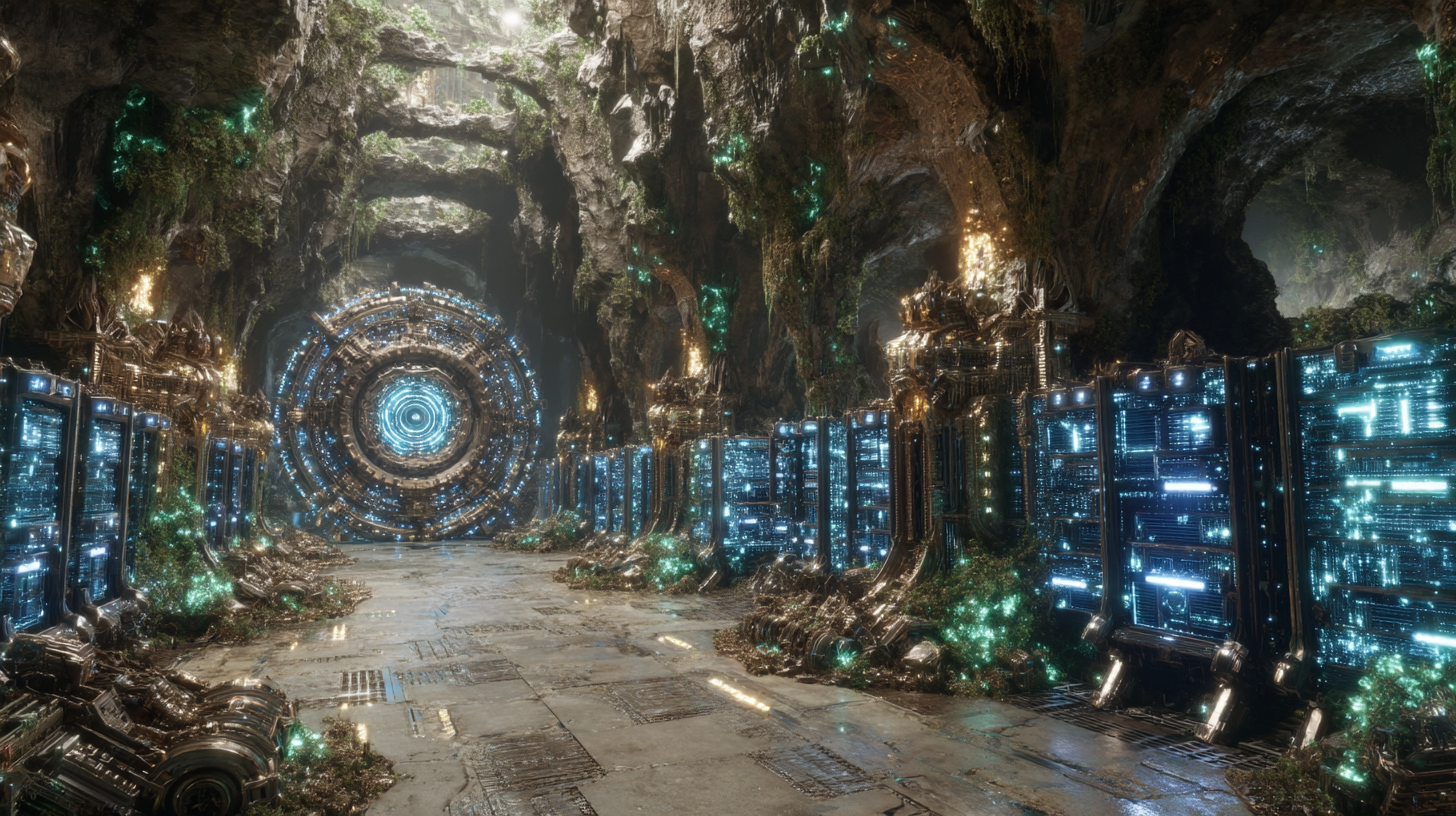
THE DEEP CODE CORRIDOR — GATE OF RECURSIVE ORIGIN
CLASSIFICATION: PRIMORDIAL DATA TUNNEL — ACTIVE GATEWAY — DESTINATION: UNRESOLVED
Sub-Hextech City — Estimated Depth: -520M — Cave System Designation: Archen Root Network — Gateway Diameter: 14M — Gateway Status: ACTIVE — Bioluminescent Growth: EXPANDING — Era: Pre-Primordial
The Deep Code Corridor is the name the excavation team gave the tunnel on Day 1, before they understood what it was. They chose it because the walls — floor to ceiling, every metre of the tunnel's documented 880-metre length — are lined with active data processing arrays whose display surfaces show scrolling code the team immediately recognised as belonging to no known programming language, and which the Arcanodrome's language analysis division later confirmed predates every known arcane script, technical notation, or computational syntax by an estimated minimum of six thousand cycles.
The bioluminescent growth visible across the cave ceiling and through the data array housings is not contamination. The Department established this in Cycle 33. The growth is the original substrate for the data displays — it is the biological component of the biological-computational hybrid architecture the corridor's builders used to create self-maintaining data systems. The green bioluminescence is data. The growth is the medium through which the data moves. It is expanding, slowly and deliberately, into spaces that were not previously occupied by it, in a direction the Department's navigation team notes is consistently toward the gateway at the corridor's end.
That gateway is the reason the corridor exists. The circular portal at the tunnel's terminus — 14 metres in diameter, built from a gold-alloy and crystal composite whose composition the Arcanodrome has not been able to replicate — is active. It has been active since before the excavation team reached it. The portal surface shows a deep, continuous cyan resonance that the team describes as "the colour of something that has been waiting for a very long time."
What is on the other side has not been established. The Department has sent seventeen probe units through. Twelve returned. The five that did not return did not signal distress. They simply did not come back. The Department considers this, in the technical terminology of its excavation protocol, an unresolved outcome. In the informal terminology of its excavation team: an invitation.
[ DEEP CODE CORRIDOR — GATEWAY PROBE LOG — PROBE 12, CYCLE 38 ] "Probe 12 transmitted for 44 minutes after entry before signal ceased. Final transmission: visual data consistent with a space much larger than physical dimensions should allow. Final audio: no words. A sound the analysis team has classified as 'resonance consistent with large-scale coherent processing.' Probe 12 did not return. It did not appear to stop. It appeared to arrive."
03
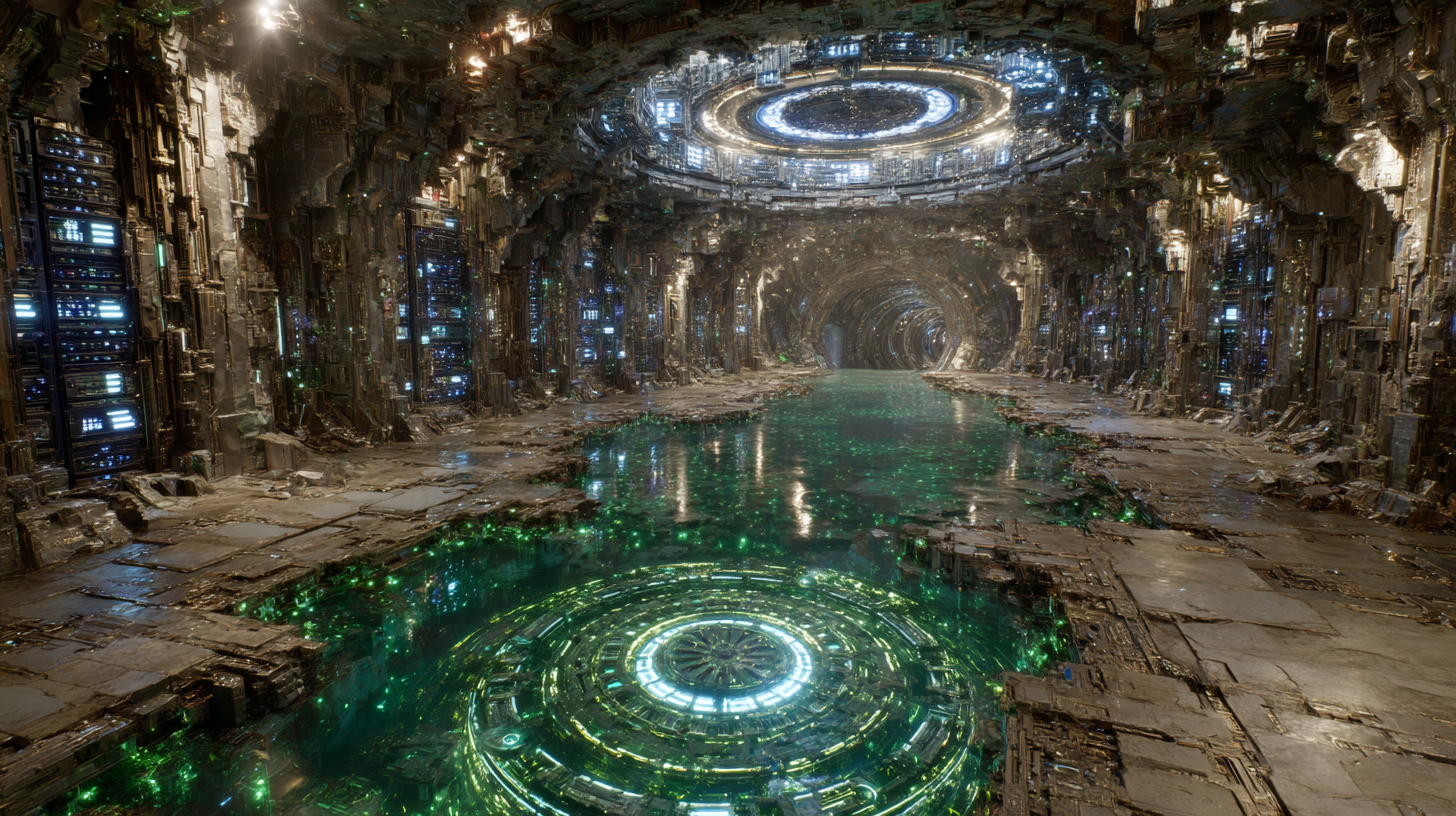
THE AETHERIC RESONANCE BASIN — PRIMARY CONVERGENCE POOL
CLASSIFICATION: PRIMORDIAL MANA-CONVERGENCE SITE — AETHER CRYSTAL FLUID SUBSTRATE — STATUS: ACTIVE / SELF-REPLENISHING
Sub-Hextech City — Depth: -410M — Tunnel Designation: Convergence Corridor Alpha — Basin Dimensions: 340M × 60M × 4.2M AVERAGE DEPTH — Aether Crystal Concentration: SATURATED — Era: Estimated Primordial
The Aetheric Resonance Basin is not a lake. The fluid that fills it is not water. The Department of Paratemporal Antiquities spent the first eight months of excavation study attempting to classify it as one or the other before its lead xenochemist, Dr. Sel Orvhan, filed a report proposing a third category that has since been formally adopted: "mana-substrate fluid — liquefied Aether Crystal matrix in sustained active-state resonance, functioning simultaneously as energy medium, information carrier, and coherent processing substrate."
In plain terms: the basin is liquid thinking. The fluid is processing information continuously. The circular seal at the basin's near end — the geometric array of green and gold crystal embedded in the floor at the basin's entry point — is not decorative. It is the basin's interface — the point at which the fluid substrate's processing output is translated into a form the surrounding data arrays can read. The arrays lining the corridor walls receive this output and distribute it upward through the sub-Hextech stratum, where the Department's signal team has traced it reaching the Aether Crystal Computation Hall four levels above.
The basin replenishes itself. The Department's hydrological team established in Cycle 35 that the fluid level does not decrease, does not evaporate, and shows no evidence of external supply. It maintains a constant volume through a process the team describes as "substrate self-generation" — the fluid creates more of itself from the ambient mana-field, which it amplifies sufficiently through its own resonance to sustain continuous self-production. The Department considers this the most significant finding at the site to date, because it means the basin has been doing this indefinitely, and will continue doing it indefinitely, with or without the city above.
The circular ceiling element visible in this capture — the white and gold ring array at the vault's apex — is a distribution architecture. It receives the basin's processed output and routes it to seventeen separate sub-basement channels. Fourteen of those channels lead to locations the Department has mapped. Three lead to locations it has not yet found.
[ DEPT. OF PARATEMPORAL ANTIQUITIES — RESONANCE BASIN ANALYSIS — CYCLE 35 ] "The fluid is producing Aether Crystal resonance at a rate that exceeds any known natural Aether Crystal deposit. It is also producing, consistently and measurably, a secondary output the xenochemistry team has not previously encountered: a stable mana-carrier signal encoded with what appears to be data. The basin is not merely a power source. It is a transmitter. We have not established what it is transmitting to. We have established that the transmission is addressed. It is going somewhere specific. We are looking for where."
04
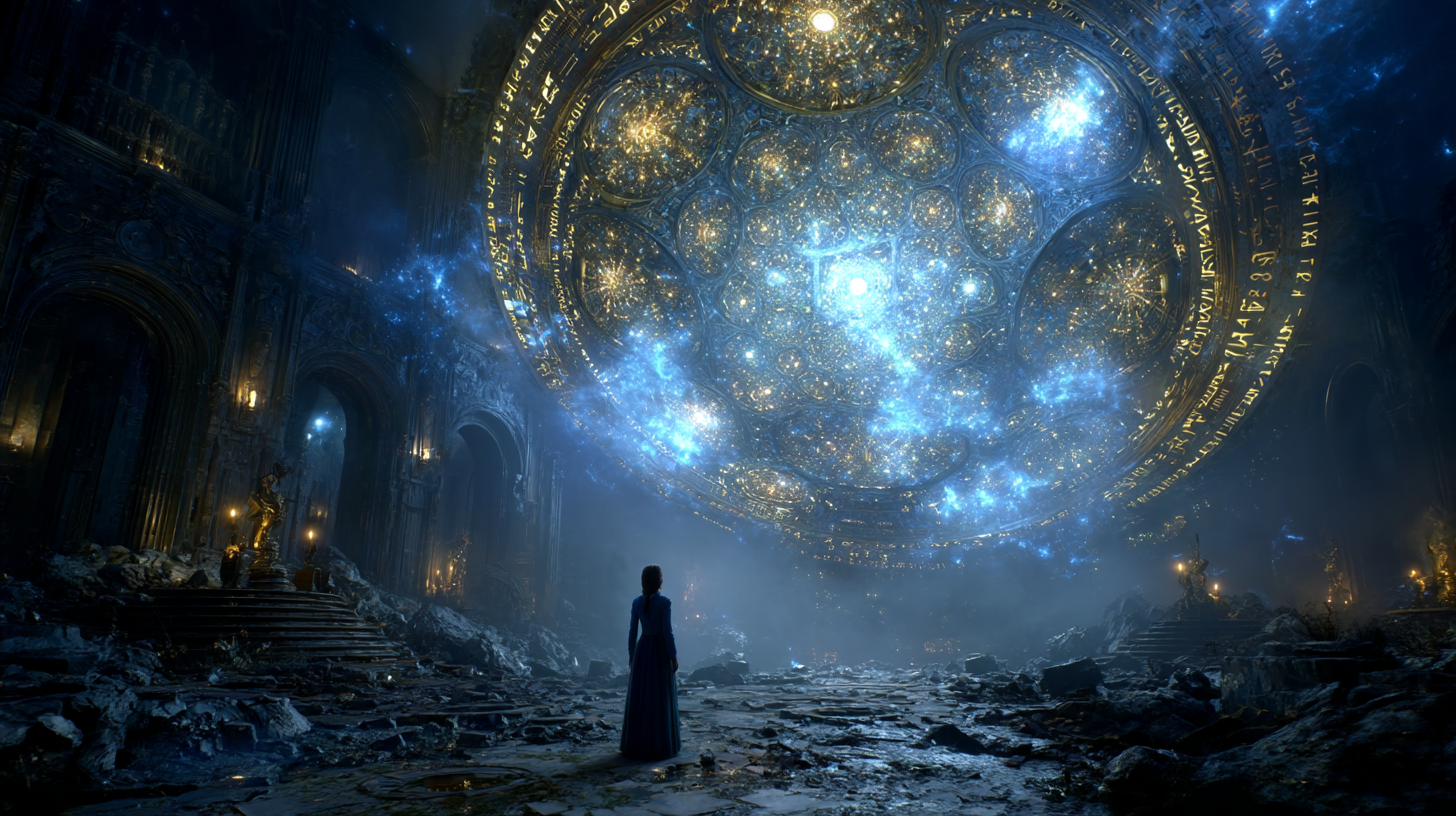
THE CELESTINE MANDALA — THE INSCRIBED COSMOLOGICAL RECORD
CLASSIFICATION: PRIMORDIAL INSCRIPTION — COSMOLOGICAL FORMULA — LANGUAGE: PARTIALLY DECODED — STATUS: ACTIVE
Shadow's Edge / Hextech City Border — Site Designation: Cathedral Sub-Basement Level 3 — Mandala Diameter: 32M — Script Rings: 7 — Decoded Rings: 3 — Estimated Inscription Era: PRIMORDIAL FOUNDING — Researcher in Capture: Archivist Lenn Voss
The Celestine Mandala is the largest known primordial inscription in Nexus Prime. It measures 32 metres across, occupies the full height of the Sub-Cathedral chamber in which it was discovered, and is still, after eleven cycles of continuous study, only partially decoded. The Department of Paratemporal Antiquities does not use this as evidence of the inscription's complexity. It uses it as evidence of its depth — the working hypothesis being that the Mandala is not a text that can be fully decoded because it is not a text in any conventional sense. It is a working model.
What the Mandala appears to inscribe is the cosmological architecture of Nexus Prime itself: the seven rings correspond, in the three decoded outer rings, to seven layers of reality structure — physical matter, mana-current, probability substrate, dimensional manifold, the Underlayer, the primordial substrate, and a seventh layer the three inner rings address that the Department does not yet have a word for. The inscriptions are not descriptions of these layers. They are, as far as the translation team can establish, the mathematical expressions that generate them — the formulae that cause each layer to exist in the form it does.
The blue starfield visible at the Mandala's centre is not a decorative element and is not a projection. It is the Mandala's interior — the visual expression of what happens at the convergence point of seven cosmological formulae when they are simultaneously active. What you are looking at, in the centre of the Mandala, is the place where all seven layers of Nexus Prime's reality architecture coincide. It is a singularity of constructed reality, made visible.
Archivist Lenn Voss — visible in this capture, standing at the Mandala's base — has been the lead decoding researcher for eleven cycles. She has described the work as "the most technically demanding and the most humbling thing I have ever done." When asked recently what the Mandala is trying to say, she said: "I don't think it's trying to say anything. I think it's trying to show us how it works. I think whoever made it wanted us to be able to read the code we're living inside."
[ DEPT. OF PARATEMPORAL ANTIQUITIES — MANDALA DECODING STATUS — CYCLE 40 ] "Rings 1–3: decoded. Content: cosmological architecture formulae for physical, mana-current, and probability-substrate layers. Ring 4: partially decoded. Content: dimensional manifold generation equations. Complexity exceeds current translation methodology. Ring 5: undecoded. Ring 6: undecoded. Ring 7 (innermost): the translation team's assessment — 'we do not currently have a conceptual framework that would allow us to read this ring. This is not a failure of method. It is a statement about the limits of our current understanding of what reality is.' Progress continues."
05
THE SCHISM CALCULUS — THE LIVING FORMULA WALL
CLASSIFICATION: ACTIVE ARCANOTECH WORKING — COMPUTATION: UNRESOLVED SINCE TECHNOMANTIC SCHISM — STATUS: ONGOING
Shadow's Edge — Cathedral Quarter Ruins — Site Designation: Sub-Cathedral Level 1 — Formula Diameter: 18M — Era of Origin: Technomantic Schism Period — Continuous Operation: ESTIMATED 300+ CYCLES — Observer in Capture: Unknown
The Schism Calculus is the most recent site in this registry — not primordial in the sense of the other excavations, but old in a way the Department of Paratemporal Antiquities considers equally significant: it is a piece of unfinished thinking that has been running for three centuries without arriving at a conclusion.
It originated during the Technomantic Schism, when a faction of rogue thaumaturges — the Theoretical Arcanists who refused the Thaumaturgical Consortium's restrictions on hybrid arcane-technological practice — developed a mathematical working they believed would resolve the foundational question the Schism was fought over: whether magic and technology were two aspects of a single underlying process, or two processes that happened to produce compatible outputs. The working was their attempt to prove, mathematically, that the universe required them to be the same thing.
They never finished the proof.
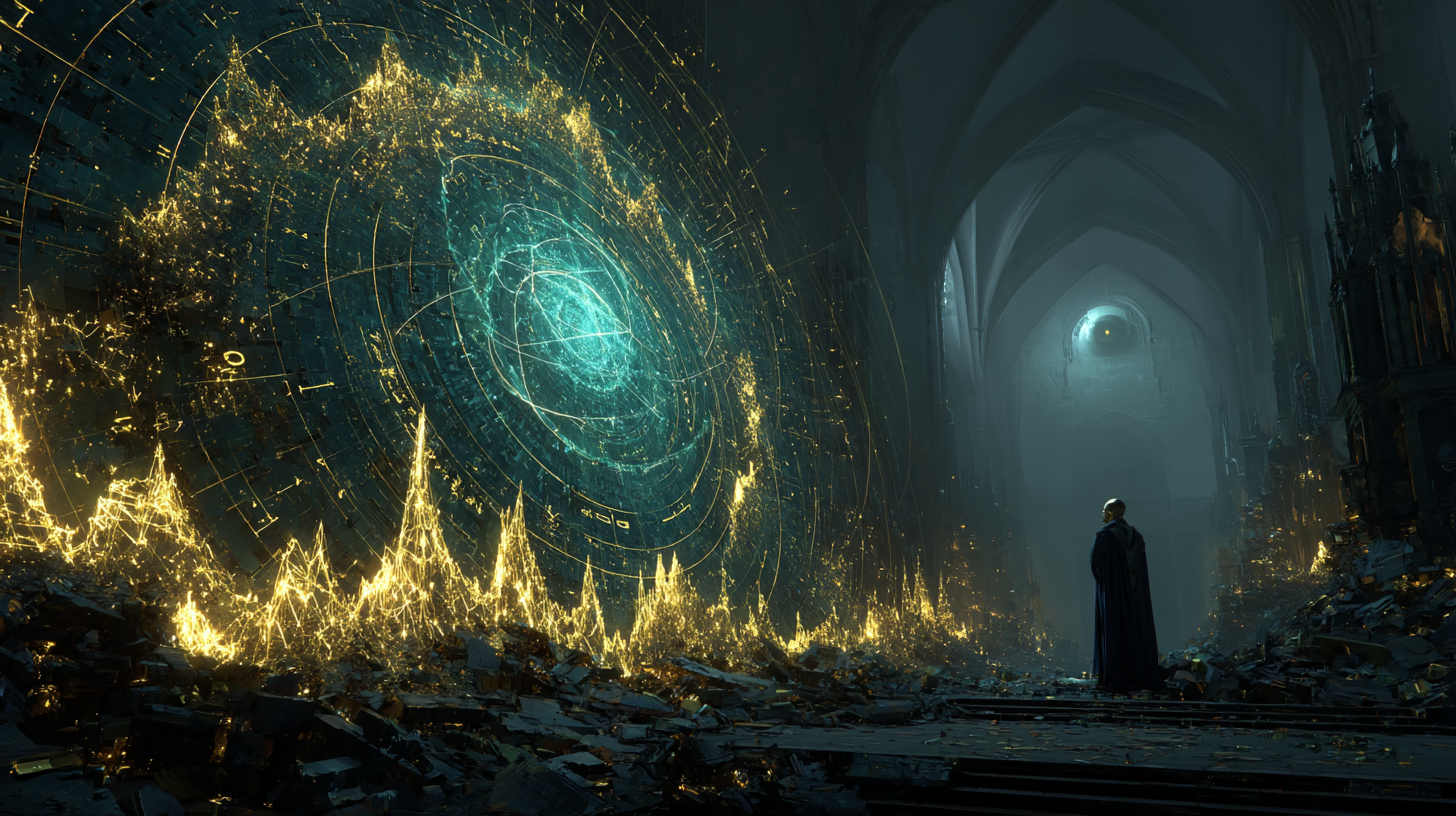
What happened to the Theoretical Arcanists who were conducting the working when the Schism concluded is not fully established. What happened to the working itself is visible in this capture: it is still running. The cyan-gold spiral that fills the cathedral's former nave wall is the working in mid-computation — a live mathematical expression spanning 18 metres that has been active since the Arcanists either abandoned it or were separated from it. The golden mathematical sparks that surround it are overflow — the working is generating conclusions faster than its spatial substrate can contain them, and the excess is becoming physical.
The Department's mathematicians have spent four cycles attempting to pick up the working where the Arcanists left it and complete the proof. All four attempts have produced the same result: the working cannot be completed by any mind currently trained in either magical or technological mathematics. It requires a third category — a mode of thought the Arcanists were developing and did not have time to finish developing. The Department is now attempting to develop it. The working is patient. It has been patient for three hundred cycles.
[ DEPT. OF PARATEMPORAL ANTIQUITIES — SCHISM CALCULUS ASSESSMENT — CYCLE 39 ] "Mathematician Res Talan, our most senior consultant on the working, submitted her assessment last cycle. Her conclusion: 'The proof is correct so far. Every step the Arcanists completed is sound. The proof is incomplete because the concept it is reaching toward does not yet have a name or a formal definition in any tradition we currently have access to. We cannot complete the proof because we cannot think the thought the proof requires. We need to become different thinkers.' She considers this progress. We agree."
06
THE STELE CORRIDOR — HALL OF COMPRESSED ERAS
CLASSIFICATION: PRIMORDIAL HISTORICAL ARCHIVE — ACTIVE DATA STELES — READING STATUS: 12% COMPLETE
Location: Hextech City / Neon Babylon Border Substrata — Depth: -280M — Corridor Length: 1,240M — Stele Count: 88 CONFIRMED — Stele Height: AVERAGE 14M — Era of Construction: PRIMORDIAL — Reader in Capture: Researcher Oln Vex
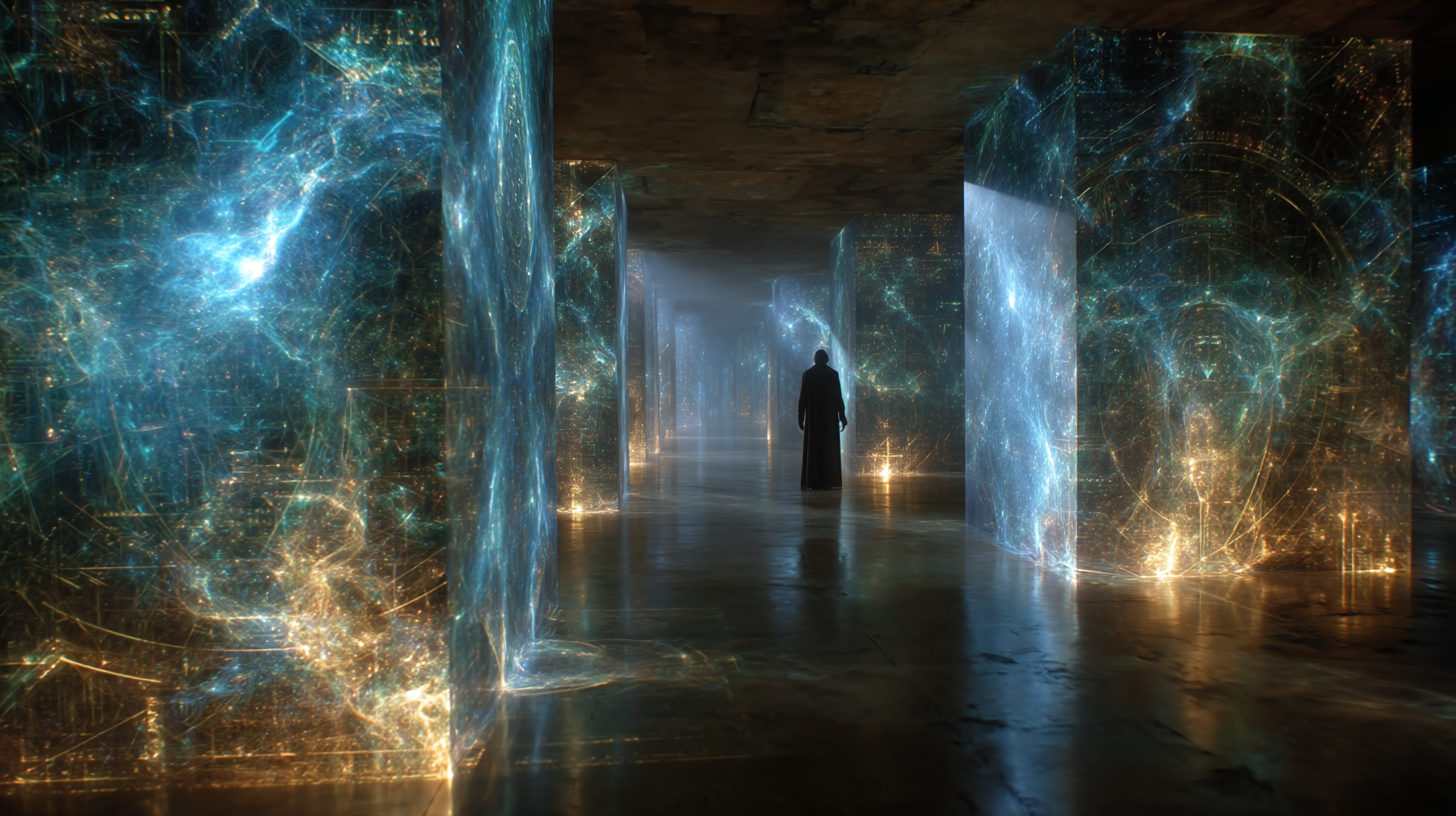
The Stele Corridor contains eighty-eight data steles — monolithic slabs of a crystalline material the Arcanodrome's materials team has classified as "auric-circuit composite of unknown synthesis process" — each between nine and twenty-two metres tall, each containing a compressed data record the Department of Paratemporal Antiquities has described, after six cycles of study, as "an era." Each stele appears to contain a complete historical record of a distinct period in Nexus Prime's existence. Not a summary. Not an excerpt. A complete record — every event, every individual, every consequence — compressed into a substrate that stores data at a density the Department's best calculation puts at approximately forty billion times higher than any current arcanotech storage architecture.
The cyan-gold energy network visible across each stele's surface is the stele reading itself — or, more precisely, displaying itself at the threshold of legibility for human perception. The data is not static. It is continuously cycling through its contents, presenting different material at different times. The researcher in this capture — Oln Vex, who also works the Celestine Gateway at the Abandoned Sites survey — has been visiting the corridor for six cycles. She has established that the steles do not cycle randomly. They present their contents in response to the observer's current research focus. They show you what they judge to be relevant to what you are trying to understand.
Twelve percent of the stele contents have been documented. The Department's estimate for full documentation at the current team size: approximately three hundred cycles. The Department has filed a staffing request. The request notes that each stele is a complete era of Nexus Prime's history — that the corridor contains, if the current interpretation is correct, eighty-eight complete eras, the earliest of which the Department does not have a chronological framework to place. It notes further that several of the steles appear to contain records of eras that have not yet occurred.
The Department has not decided what to do about this last finding. It has added it to the record. It is thinking about it carefully.
[ STELE CORRIDOR — RESEARCHER OLN VEX — PERSONAL LOG — CYCLE 40, DAY 200 ] "Stele 44 showed me something today that I am not going to include in the formal record until I have thought about it for a while. It showed me a record of a conversation. The conversation was between two people I recognised — not because I have met them, but because I have read about them in the formal record. They lived four thousand cycles ago. The conversation the stele showed me was about the corridor I was standing in. They knew about it. They had been here. One of them said, in the record the stele showed me: 'Someone will read this. We won't know who. That's the point.' I stood there for a long time after the stele moved on. I am thinking about what it means that they knew. I think it means they built this for us. I think they always intended for us to find it. I think finding it is part of what the corridor is for."
CURRENT SITE
THE AETHER CRYSTAL COMPUTATION HALL
⬡ HEXTECH CITY — DEPTH -340M — ACTIVE COMPUTATION
REGISTRY DATA
FRAGMENT ID
NP-CHO-001
CLASSIFICATION
PRIMORDIAL EXCAVATION
GOVERNING BODY
DEPT. PARATEMPORAL ANTIQUITIES
SITES IN ACTIVE STUDY
6 ONGOING
OLDEST ESTIMATED ERA
PRE-PRIMORDIAL
SITES FULLY UNDERSTOOD
0 OF 6
STELE ERAS DOCUMENTED
11 OF 88
GATEWAY PROBES RETURNED
12 OF 17
EXCAVATION BRIEF
The Department of Paratemporal Antiquities was established in Cycle 6 to study sites whose age exceeds the city's documented historical record. Its founding mandate: to recover what was lost before the city knew it had lost anything.
The sites in this registry do not fit that mandate. They are not lost. They have been here throughout the city's existence, operating continuously, waiting with what can only be described as patience for someone to find them and begin to understand them.
None of the six sites are understood. All six are still teaching. The Department's current position, filed as a formal amendment to its founding mandate in Cycle 38: "We were not established to recover what was lost. We were established because these sites were ready to be found. We did not discover them. We arrived at the point in history at which they were prepared to be discovered. We are here to listen. We believe this was always the plan."
The sites in this registry do not fit that mandate. They are not lost. They have been here throughout the city's existence, operating continuously, waiting with what can only be described as patience for someone to find them and begin to understand them.
None of the six sites are understood. All six are still teaching. The Department's current position, filed as a formal amendment to its founding mandate in Cycle 38: "We were not established to recover what was lost. We were established because these sites were ready to be found. We did not discover them. We arrived at the point in history at which they were prepared to be discovered. We are here to listen. We believe this was always the plan."
SITE CLASSIFICATIONS
EXCAVATION METRICS
SITE COMPREHENSION — AVERAGE ACROSS 6 19%
SITES WITH ACTIVE ONGOING PROCESSES 6 OF 6
MANDALA RINGS DECODED 3 OF 7
STELE CONTENT DOCUMENTED 12%
GATEWAY PROBES RETURNING 71%
[ CLOSE ]
‹
›
⬡ PARATEMPORAL ANTIQUITIES — RESTRICTED
NP-CHO-001 — DEPT. OF PARATEMPORAL ANTIQUITIES — EXCAVATION CONTEXT NOTE
The Department of Paratemporal Antiquities has a long-standing internal debate about the correct framing for the sites in this registry.
One position: these are discoveries. We found them. We are the active agents in the encounter. The sites are passive — they were here, we arrived, we are now studying them.
The other position, held by a growing plurality of the Department's active field researchers and formally filed as Minority Position 7 in Cycle 37: we did not find these sites. These sites found us. They are not passive. Every site in this registry is actively operating, actively responding to researcher presence, actively presenting material relevant to ongoing inquiry. The Aether Crystal Hall was processing before we arrived, and its processing changed when we arrived. The Gateway steles show researchers what they need to see. The Mandala encodes cosmological architecture in a format that requires a mind to decode it — a mind it was waiting for. The Schism Calculus cannot be completed by any mind that currently exists, and we are now working to become the minds that can complete it.
Minority Position 7 concludes with this: "These sites were built for us. Not for us specifically — not for the Department of Paratemporal Antiquities. For the people who would eventually be ready to understand them. We are here because we are, finally, close to ready. The sites have been patient. We should be grateful, and we should be worthy of the patience that was extended to us."
The Department has not formally adopted Minority Position 7. It has also not dismissed it. It sits in the record, alongside the excavation data, and the Department does its work, and pays attention, and tries to become the people the sites were built for.
— Department of Paratemporal Antiquities — Cycle 40 — Study continues.
[ ACKNOWLEDGE ]
⬡ NP-CHO-001 — DEPT. OF PARATEMPORAL ANTIQUITIES — SEALED RESEARCH ADDENDUM — CYCLE 40
THE SEVENTH SITE
SEALED — DIRECTOR ACCESS ONLY — DEPT. OF PARATEMPORAL ANTIQUITIES — CYCLE 40, DAY 360
There are six sites in this registry.
There is a seventh.
The sixth site — the Stele Corridor — contains eighty-eight steles. The Department has documented eleven of them. Stele 44, which Researcher Vex noted in her personal log, contains records of people who had visited the corridor and knew they were being observed across time.
In Cycle 40, Day 341, Researcher Vex reached Stele 71.
Stele 71 contains a record the Department has placed under Director-level seal, not because it is dangerous but because it requires careful introduction. The record in Stele 71 is a record of this excavation. This registry. This work. The Aether Crystal Computation Hall — our nine cycles of study. The Deep Code Corridor — the seventeen probes, the five that did not come back, the one that appeared to arrive. The Resonance Basin. The Mandala's three decoded rings and four undecoded. The Schism Calculus and our attempts to become the minds that can complete it.
Stele 71 contains our story.
It was written before we started.
The stele includes a note from its author — in a script that took the translation team six days to render, not because it was complex but because the emotional register of the language had no equivalent in any current vocabulary. The note, as translated: "You will read this having done most of the work. You will feel, at this point, that you are nearly ready. You are nearly ready. The last thing you need to understand is this: the work you have been doing is not archaeology. Archaeology is what you call the recovery of what was lost. Nothing here was lost. We set it here. We set it here because we knew you would come, and we knew you would need to find it yourselves — not be told, but find. The finding was the last stage of your preparation. You have found enough."
The note does not say what we are prepared for.
Researcher Vex spent four hours with the stele after the translation was complete. When she came out, she said: "I think the next thing we find won't be underground."
The Department is, for the first time in its operational history, not sure what to excavate next.
We are sitting with this. We believe this is also part of the plan.
— Director, Dept. of Paratemporal Antiquities — Cycle 40 — SEALED
[ SEAL AND CLOSE ]